Six Prints, One Cork Board, Thirty-One Days: What a Village Hall Taught Me About My Own Work
There is a particular silence that follows a deadline. You send the files, you close the laptop, and then you wait for something to happen. Usually what happens is a number: impressions, saves, a graph that climbs and then sags. It tells you plenty about reach and almost nothing about whether the thing you made is any good.
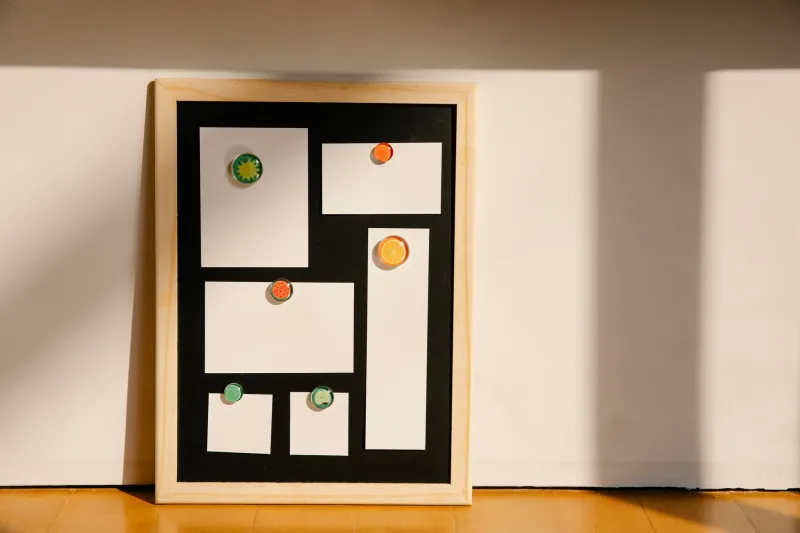
So in September I tried something daft and faintly embarrassing. I printed six pieces from my portfolio at A4, mounted them on cheap grey board, and pinned them to the noticeboard in the village hall down the road. Then I left them there for a month and asked the caretaker to keep half an eye on things.
The hall is the usual sort of building — pebbledash, a draughty porch, a tea urn that has clearly seen things. The board by the door carries a jumble of notices: a parish council agenda, a ballet class for under-fives, a missing cat called Bernard, a poster for a Christmas fair in a font that should be illegal. My six prints went up among them on a Tuesday morning.
The rules I set myself
No QR code. No website address. No caption explaining what any of it was. If a piece can't survive without a paragraph of context, I wanted to find that out the hard way.
I also resisted the urge to hover. I did not stand in the porch pretending to read the recycling timetable while watching people's faces. That would have been unbearable for everyone. Instead I relied on the caretaker, a retired schoolteacher called Margaret, who agreed to note down anything she overheard.
What people actually stopped for
Margaret's log was wonderfully unsentimental. Across four weeks she recorded eleven occasions where somebody paused in front of the board for more than a few seconds and said something out loud.
The piece people stopped for most was not the one I'd have chosen. It was a spare, high-contrast poster I'd made for a small music night in Norwich — one shape, two colours, a lot of empty space. People read it. A few of them read it out loud. One man apparently said, 'Well, that's clear, isn't it,' which is possibly the nicest thing anyone has ever said about my work.
The piece I was proudest of — a dense, layered collage with hand-lettering and about nine competing ideas — got almost no reaction at all. Somebody had pinned a brownie-baking rota partly over it by week two, and honestly, the rota improved the composition.
Scale is a ruthless editor
What I hadn't accounted for is how far away people stand from a noticeboard. Roughly a metre and a half, maybe two, in a hallway with poor light. Detail you've spent hours on becomes a smudge. Thin lines vanish. Twelve shades of grey collapse into one slightly muddy grey.
I talked to Dev Patel, a letterpress printer in Sheffield who has been putting work in front of people at fairs and market stalls for the better part of twenty years. He wasn't remotely surprised.
'On a screen you can lean in,' he said. 'On a wall you can't. You've got about a second and a half to say something, and if the saying needs a small font, it isn't going to get said.'
His rule for anything destined for public display is blunt: print it, stick it on the fridge, walk to the other side of the kitchen, and squint. If it still works, it survives. If you have to walk towards it, it doesn't.
The text problem
Of the six prints, three had significant text in them. Two failed the hallway test because the type was too small to parse from standing distance, and one failed because I'd used a condensed face that looked elegant on my monitor and like a barcode at arm's length.
The poster that worked had eight words on it. That's it. Eight words, one of which was a date.
I asked Margaret why she thought people engaged with it. Her answer was the sort of thing you can't get from a heatmap: 'It looked like it was meant for them,' she said. 'The others looked like they were meant for somebody else and had ended up here by mistake.'
That one landed like a brick. Because she was right. The collage was made to impress a version of my peers who were never going to walk into that hall. The poster was made to communicate with whoever happened to be passing. Only one of those is a transferable skill.
The thing I didn't expect
By the end of the month, three people had asked Margaret who did the prints, and one had asked whether the artist might make a poster for the church fete next summer. Not a commission I'd have chased, but a genuine, unforced enquiry from someone who had seen the work cold, in the wild, with no framing device telling them how to feel about it.
That is worth more than it sounds. Nobody was being polite. Nobody was doing the social media thing of complimenting a thing while scrolling past it. They'd stopped because something caught their eye in a draughty corridor, and then they'd asked a follow-up question.
What I'm doing differently
I've changed how I present work on my own site since — fewer pieces per page, bigger, fewer words. I've started printing everything at A4 and blu-tacking it to the kitchen wall before I call it finished. And I've quietly retired the collage, or at least demoted it to the bit of the portfolio where things go to be looked at closely by people who already like me.
The whole exercise cost about eleven pounds in printing and a mild amount of dignity. If you make things and you've been living off analytics for a while, I'd recommend it. Find a board, a window, a cafe, a laundrette. Put six things up. Say nothing. Then listen to what people say when they don't know you're listening.