Small, Pointless and Worth Doing: Three Low-Stakes Projects to Start This Winter
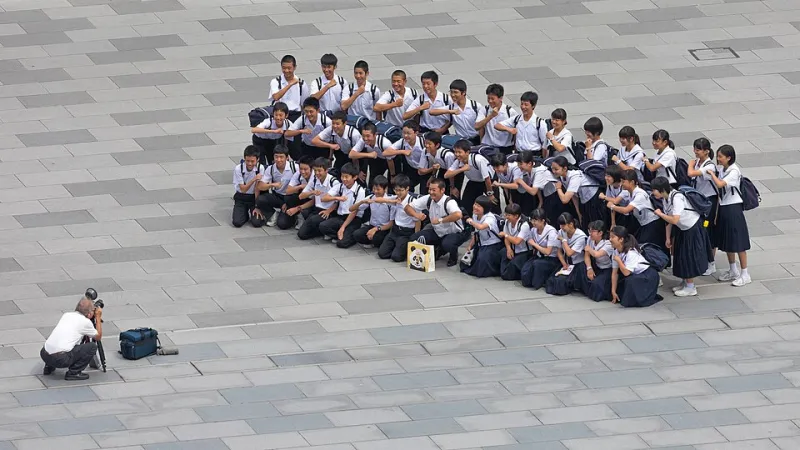
Photo: Basile Morin, CC BY-SA 4.0, via Wikimedia Commons
I've got a folder on my desktop called 'maybe'. It's full of things that were nearly good ideas and then got politely killed by the question: what's it for?
That question is a menace. It sounds sensible, it's usually asked by someone who loves you, and it has quietly closed more interesting doors than any lack of talent ever did. So this is an argument for the opposite: projects that are deliberately unambitious. No audience. No plan to monetise. No chance of being the thing you're introduced by at a party.
Here's why they're worth your evenings anyway, and three you could start before the month's out.
Unambitious is a design feature, not a failure
When a project has ambitions, it inherits obligations. An audience needs feeding. A monetisation plan needs a shop, a mailing list, a set of terms. Even a modest portfolio piece comes with the pressure to make it look like it took effort.
A project with none of that is free in a way that's surprisingly rare. You can be bad at it. You can stop for three weeks. You can change the rules halfway through because you felt like it. And because nothing is riding on it, you end up making decisions on the basis of what you actually find interesting, which is a muscle that atrophies quickly when you're being paid to have opinions on demand.
I'd go further. The unambitious side project is often where your real taste goes to recover. It's the equivalent of a walk with no destination.
The only rule I'd insist on: it can't be a stepping stone. The moment you start thinking about how to share it properly, you've quietly promoted it and ruined it.
Three to try, all cheap, all very British
These cost close to nothing, need no permission, and can be done on a lunch break or a wet Saturday. Pick one. Not three.
1. A local photo walk series
One route. Walk it once a week for six weeks, same time of day, and take photographs with a single constraint — one focal length, or only things above head height, or only front doors. The point isn't the pictures. It's that repeating a route makes you notice change: the scaffolding going up, the shop that quietly closed, the way the light moves round by mid-November.
What it gives back: patience, and a proper look at the place you actually live rather than the version of it you describe to people. Six weeks of a suburban high street will teach you more about framing than a weekend workshop. It also gives you a stack of images that are nobody's business but yours.
Practical notes: parking restrictions are the real enemy. Go early. Keep the camera in a coat pocket rather than a bag, or you'll stop taking it.
2. A one-page zine swap
Make one A4 sheet, fold it into eight pages, fill it with whatever you've got — a list, a drawing, a bad poem, a map of your route to the shop. Then post it to one person, and ask them to post one back. That's the whole scheme.
The constraint is the joy here. Eight small panels is roughly the amount of space most ideas actually deserve. And folding a sheet is a decision you can't overthink, which is a gift if you're the sort of person who has seventeen versions of a logo file.
What it gives back: an audience of exactly one, which is the least intimidating audience there is, and a reason to finish something in an afternoon. It's also genuinely nice to receive post that isn't a bill. Royal Mail will do the rest for the price of a large letter.
Practical notes: agree a rough date with your swap partner or you'll both drift. Keep the original flat until it's posted — folded zines get lost under things.
3. A found-sign typography log
Photograph lettering in the wild and keep them in a log. Not the good stuff — the patched-up stuff. Hand-painted fascias, a beauty salon with three typefaces fighting, a parish noticeboard with vinyl letters peeling off, a 'No Ball Games' sign in a font that has clearly given up.
One entry a day, or ten a week, whatever suits. Note the location, the date and one sentence about why it caught your eye. Don't tidy it into a grid. It's a log, not a poster.
What it gives back: you start seeing letterforms everywhere, which changes how you make them. After a couple of months the log becomes an accidental record of how a town actually presents itself, which is far more interesting than any curated moodboard. It's also a very good excuse to look up while walking, which is its own reward.
Practical notes: photograph from the pavement, not the middle of the road. Be discreet with people's shopfronts — a quick snap, then move on.
What to do with the results (nothing)
The hard part isn't starting. It's resisting the urge to make it into something. Six weeks of photo walks becomes a zine, the zine becomes a shop, the shop becomes a second job you didn't want.
So put a fence round it. No sharing, or sharing only with one person. No naming it after yourself. No counting anything you don't need to count.
If, after a few months, one of them turns out to be quietly the most interesting thing you're doing, you'll know. It'll survive on its own merits, without a plan propping it up. And if it doesn't, you'll have had a decent winter of looking at your own town properly, which is not nothing.
Start badly. Start small. Start this week, before the ambition gets back from wherever it goes.