The Borrowed Half: What Four Weeks of Sharing a Bench Taught Me About My Own Routine
There is a particular kind of silence in a studio at 8:15 in the morning. It is the sound of the kettle not yet boiled, the radio still on the previous day's station, and a half-finished thing on the bench that you have not decided whether to love or sand back into oblivion. I know that silence well. For four weeks this autumn, I did not have it to myself.
Her name is Jules. She makes small-batch ceramics and lives two streets over. When she asked whether I knew anywhere she could work while her garage was being rewired, I heard myself offer half my bench before my brain had a chance to weigh in. Four weeks, I said. Bring your own apron. I immediately regretted it, then spent a Sunday clearing space and pretending I hadn't.
This is a log of what happened, written mostly in the evenings with clay under my fingernails and a growing awareness that the problem was never going to be her.
The line on the bench was the easy part
We agreed on the obvious things first. She would take the left half, I would keep the right. A strip of masking tape marked the border, mostly as a joke. The drying rack was shared but scheduled: her pieces on the top two shelves, mine below. The kettle was neutral territory. The radio was a negotiation.
What I did not expect was how quickly the tape stopped mattering and how quickly the small stuff started to. She stacks her tools differently. She wipes a surface before she starts, not after. She keeps a spray bottle of water on the windowsill, which I found oddly irritating for reasons I could not defend. None of this was wrong. It was just not mine.
Territory, it turns out, is rarely about the big half of the bench. It is about where the scissors live and whether the light falls on your work at 2pm. We sorted it in a series of two-minute conversations, usually while waiting for the kettle. No big sit-down. Just small adjustments, offered and accepted.
Borrowed tools and the confidence that comes with them
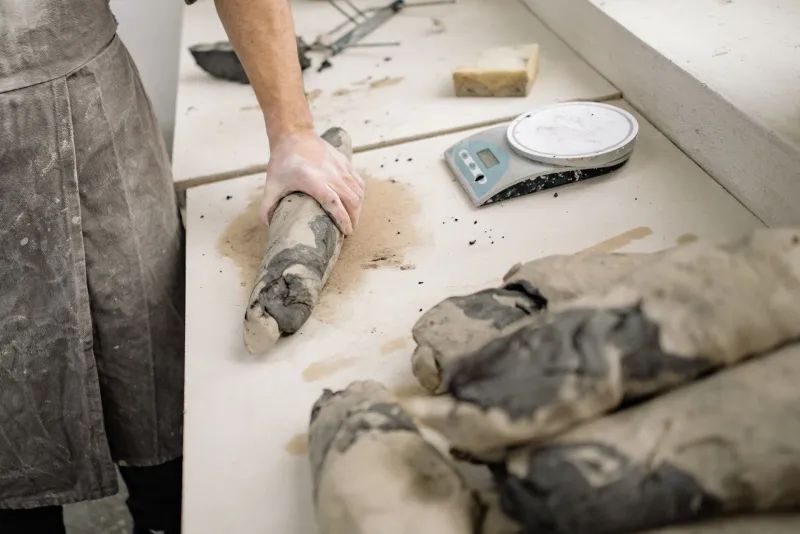
Jules brought a small set of her own tools and borrowed a few of mine. My good smoothing rib, my spare apron, a rolling pin that has been in the family since a kitchen clear-out in 2019. I watched her use them with a kind of low-level anxiety that surprised me. Would she chip the rib? Would she put the rolling pin back with flour on it?
She did neither. She was, in fact, more careful than I am. She rinsed the rib and left it on a cloth to dry. She put the rolling pin back exactly where she found it, which is more than I can say for myself on a Thursday.
What I noticed was that my own habits became visible in comparison. I leave clay scraps on the bench overnight. I put tools down wherever they land and then spend ten minutes looking for them. I start three things and finish one. None of this is new information, but watching someone else work neatly next to me made it impossible to ignore.
Feedback when someone is standing right there
The biggest surprise was the feedback. Not formal critique. Just the small comments that happen when two people are working in the same room and one of them glances over.
'Are you going to leave that edge rough?' Jules asked on the second Tuesday. I said yes, that was the plan. She nodded and went back to her work. I spent the next hour looking at the edge. By the end of the day I had smoothed it. Not because she told me to, but because the question had made me actually look at it.
This is different from feedback by email or over a pint. When someone is standing two feet away, there is no performance to it. They are not being polite. They are just seeing what is there. I found it unnervingly useful.
The daily rhythm I didn't know I had
I keep a rough log of my days anyway, mostly to see where the time goes. Four weeks of sharing a bench turned that log into something closer to a mirror.
My mornings are for thinking. I make tea, I stand around, I move things from one side of the bench to the other and call it preparation. Jules arrives at 9:30 and starts work almost immediately. By 10am she has made something. By 10:30 I am still deciding which tool to use.
This is not a criticism of either approach. But seeing it side by side made me realise that I had been calling something 'process' that was actually just hesitation. I have since started giving myself a small, specific task to do before 10am. Nothing grand. Wedge the clay. Cut the paper. Sand the edge. It has made a genuine difference to how the rest of the day goes.
The thing I got wrong
About ten days in, I caught myself hovering. Jules was using my small wooden modelling tool, the one I have had for years, and she was using it in a way I would not have. I did not say anything, but I must have looked like a man watching someone parallel park his car. She noticed. She put the tool down and said, 'Do you want this back?'
I said no. But the moment had already done its damage. She was more careful after that, more hesitant. I had made my bench feel like a loan rather than a share.
We talked about it the next day. I apologised, properly. She said it was fine, but I could tell it had lodged somewhere. The lesson was not subtle: if you are going to share a space, you have to actually share it. Not just the surface. The trust, too.
What four weeks actually changed
Jules's garage is rewired now. She came by on the last Friday to collect her things, and we had a cup of tea on the bench that was about to become entirely mine again. I expected to feel relief. Instead I felt a bit flat.
The studio is quieter now. Neater, too, because some of her habits have stuck. I wipe the surface before I start. I put the scissors back. I still leave clay scraps overnight, but I am working on it.
The bigger change is in how I think about my own routine. Sharing a bench did not teach me a new way to work. It showed me the one I already had, with all its odd little corners and excuses. That is worth four weeks of slightly awkward kettle conversations.
If another maker asks to borrow half your bench, say yes. Clear the space. Draw the line. Then watch what you do when someone else is watching, because that is where the useful stuff lives.