Shopping the Shelf: A Month of Making With Only What Was Already in the Studio
The rule was simple enough to fit on a strip of masking tape: for thirty days, nothing new comes into the studio. No paper, no paint, no frames, no fixings, no clever little gadgets from a supplier email. If a project needed something, the shelf had to provide it or the project waited.
I stuck that tape above my desk on 1 October, mostly as a joke at my own expense. I had spent the summer buying things for the version of me who makes work constantly — the me with endless evenings and no day job. The actual me had four half-finished frames, a drawer of mismatched fixings and enough paper to wallpaper a small hallway.
Why Bother, Really
The honest reason was money. The heating goes on in October, the electricity bill arrives with a personality, and every UK maker I know has been doing quiet arithmetic since the clocks changed. But the louder reason was clutter. Somewhere in the last two years, browsing had replaced making as my default evening activity. Filling a basket felt like progress. It wasn't.
Thirty days felt long enough to be a proper test and short enough that I wouldn't quietly abandon it in week two. I told three people, which is the cheapest accountability system going.
Week One: Enthusiasm With a Slight Smell of Panic
The first seven days were genuinely good. I rediscovered a block of watercolour paper I'd bought in a sale and never opened, and made four small pieces that I actually like. The constraint did what everyone says constraint does: it pushed me towards decisions rather than shopping.
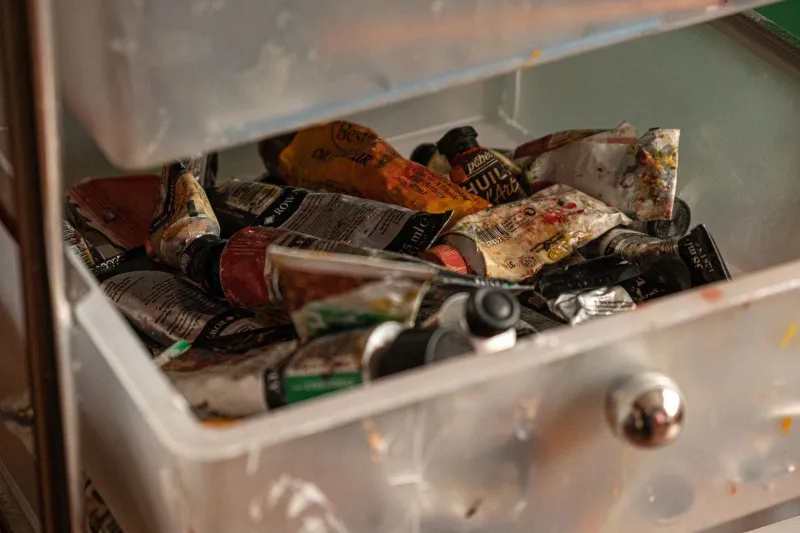
But by day five the small panics started. I needed a specific grey. Not any grey — the grey. I had eleven tubes of paint and none of them were it, and I caught myself composing a mental basket for the art shop on the high street. I didn't go. I mixed a grey from what was there, and it was wrong for about twenty minutes and then it was fine.
That's the first thing the month taught me: a lot of my “I need this specific thing” is really “I don't want to make a decision yet”.
The Awkward Middle
Days twelve to twenty-two were the slog. Not because I ran out of materials, but because I ran out of the interesting ones. The good paper was gone. What remained was a pad of thin stuff that buckles if you look at it wrong, and a stack of offcuts too small for anything but tests.
So I made tests. Dozens of them. Tiny colour studies on the buckled paper, which turned out to be perfect for it precisely because I didn't care about wasting it. I stopped thinking of it as a lesser material and started thinking of it as scrap with permission.
The frames were the real problem. I had four, and three were the wrong size for anything I'd made. For a week they sat on the bench like a rebuke. Then I took one apart, reused the moulding, and built a smaller frame around a piece that had been leaning against the wall since August. It's slightly out of square. It's hanging in my hallway anyway.
Workarounds Worth Stealing
A few things worked well enough that I've kept them:
- The scrap drawer became the first stop, not the last. Offcuts, misprints, test sheets — all of it went into one tray at eye level. Half of October's output started there.
- Fixed what I had instead of replacing it. Two brushes that had been written off came back with a proper clean and a bit of soap. One clamp got a new pad cut from an old mouse mat.
- Borrowed instead of bought. A friend lent me a hole punch. It took one message and cost nothing, and I should have asked eighteen months ago.
- Let some projects wait. Two ideas went into a notebook marked “after the 30th”. Writing them down stopped them nagging.
The Shelf Audit
On 31 October I took everything off the shelves and put it on the floor. It looked ridiculous — a small mountain of good intentions.
Roughly a third of it went. Duplicates, dried-out tubes, paper bought for a project I no longer remember, a set of fixings for a frame size I don't use. Some went to recycling, some to a maker up the road, one bag to the charity shop.
Another third earned a clear, labelled place: the paints I actually reach for, one good pad, the fixings that match the frames I actually own, the tools that get used weekly rather than aspirationally.
The last third is on probation. It's in a box with a date on it. If I haven't touched it by the end of February, it goes. That felt fairer than deciding everything in a single ruthless afternoon.
The surprise was how little correlation there was between price and usefulness. The cheapest things — a roll of kraft paper, a decent pencil, that buckled pad — did most of the work. The expensive things mostly sat there looking professional.
What I'd Tell You Before You Try It
Pick a start date and write the rule down somewhere you'll see it. Don't include a loophole for “essentials” unless you're honest about what that word means — mine would have swallowed the whole month.
Expect the middle to be boring rather than dramatic. The interesting part isn't deprivation; it's the moment you stop browsing and start deciding.
And do the audit at the end, properly, with everything on the floor. The month taught me to make with less. The audit taught me why I had so much in the first place, which is the more useful lesson heading into a winter where every maker I know is counting.