Two Hours After the House Goes Quiet: A Six-Month Evening Studio Report
There is a particular sound a house makes at ten to nine. The dishwasher clicks off. Someone upstairs stops moving. The kettle goes on because it is the law. For six months this year, that sound was my cue to go to work.
I didn't choose the 9pm start out of romance. Daytime commitments had eaten the old studio hours — the long Tuesday afternoons, the Friday mornings I used to guard like a border. By late spring, the only honest block left was the two hours after the house went quiet. So I made it a rule: creative work happens between nine and eleven, four nights a week, and not at any other time. Six months later, I have opinions.
The rules, which were less dramatic than they sound
The setup was deliberately boring. Four nights a week, Monday to Thursday. A timer set for two hours. One project on the desk, not three. No email, no admin, no "just quickly" checking anything. If I finished early, I stopped early. If I was mid-flow at eleven, I stopped anyway and wrote one sentence about where to pick up.
The first fortnight was awful. I'd sit down at nine with the day still buzzing in my head and spend twenty minutes making tea and rearranging the lamp. By the end of week two, I'd learned to leave a note on the desk the night before — literally a scrap of paper saying start here — so the first move was already decided. That single habit did more for the experiment than any app or planner.
What actually got finished
More than I expected, and less of what I'd assumed. The finished list over six months looked like this: a twelve-page zine that had been half-done since 2024, a set of nine small linocuts, a rebuilt portfolio page, and a short newsletter that went out every other Friday without fail.
The things that did not get finished are just as telling. A long-form essay I'd been circling for a year never found traction in two-hour slices. Neither did the bigger, messier project I'd been calling "the book thing" — it needed longer stretches and a different kind of attention. I stopped pretending otherwise around month three, which was oddly freeing.
What quietly fell away
The admin, mostly. The 9pm rule acted like a bouncer for anything that wasn't actual making. Invoices, email replies, browsing for frames, reading about other people's work — none of it was allowed through the door. I won't pretend that was entirely healthy; some of it piled up for Saturday mornings. But it revealed how much of my old "studio time" had been admin wearing a creative hat.
The other thing that fell away was the warm-up. In the daytime I used to ease in with a bit of tidying, a bit of scrolling, a slow cup of tea. At 9pm there was no room for that. You either started or you didn't. I started more often than not, and I think the reason was simple: the window was short enough that wasting it felt genuinely stupid.
What the darkness did
I'd braced for the winter to ruin it. The clocks went back in late October, the light fell away by half four, and I assumed the evening sessions would get heavier and slower. The opposite happened.
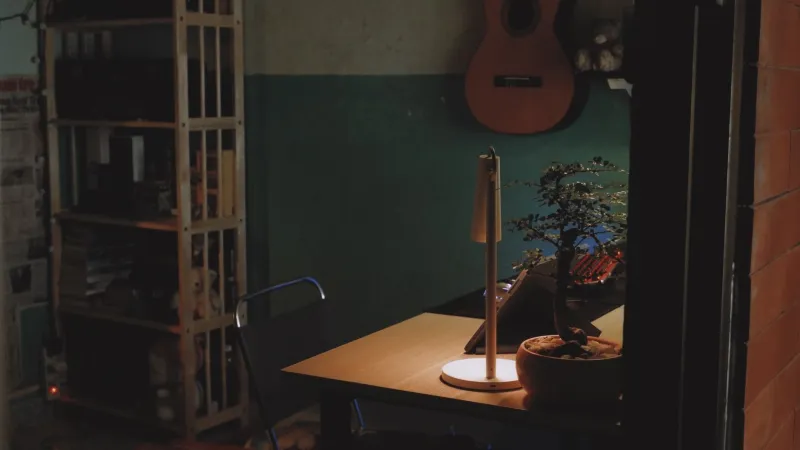
Working under a single lamp in a dark room turned out to be strangely clarifying. There was less to look at, so I looked at the work. Colour decisions got harder — I learned not to judge a print's true colour after 9pm — but focus got easier. The darkness gave the two hours an edge, a sense of being inside something rather than drifting through it.
I also noticed the quality of the starting improved. In summer, 9pm still felt like daytime, and I'd dawdle. In November, 9pm felt like the last train, and I'd get on with it. There's something useful about a window that feels slightly too short.
The real finding: momentum is a container, not a mood
Before this, I thought momentum was something you caught, like a cold or a good idea. Six months of the 9pm window taught me it's closer to a container. The rule did the work my motivation used to do. I didn't need to feel like making things; I needed to know exactly when and where I would, and to have the first move already written down.
The hard stop mattered as much as the start. At eleven, I'd down tools even if it was going well. That felt wrong for weeks, then became the thing that made the next night easy. Leaving a thread unspooled meant I arrived the following evening with somewhere to go.
If you're thinking of trying something similar, here's the checklist I'd hand you — no apps, no systems, just the bits that actually helped.
A practical checklist for an evening-only window
- Pick a hard start and a hard stop. Two hours, four nights a week, is plenty. The stop is not optional.
- Pre-stage the desk the night before. One project out, everything else away, a scrap of paper saying start here.
- Ban admin from the window. It will try to get in wearing a lanyard. Say no.
- Do the first ten minutes badly. Momentum arrives after you've started, not before.
- Judge colour in daylight. Evening lamps lie about blues and greens.
- Keep a one-line log of what you finished. Not what you did — what got finished. It's the only honest measure.
- Protect one longer slot elsewhere. The 9pm window is brilliant for small, steady work and hopeless for anything that needs a long run-up.
- Expect the first fortnight to be rubbish. It is. Then it isn't.
The experiment ended in November, not because it failed but because the daytime commitments shifted again. I've kept the 9pm habit anyway, at least three nights a week. The house still makes that sound at ten to nine, and I still put the kettle on. Then I go to work.