Dust, Blue Tape and a Half-Sanded Frame: Lessons From an Open Studio Weekend
The Shelf I Almost Didn't Bring
Last month I did an open studios weekend in a converted chapel on the edge of Bristol. I had a wall of finished work, a price list, a card reader and a flask of tea that went cold by eleven. I also had a shelf I nearly left at home.
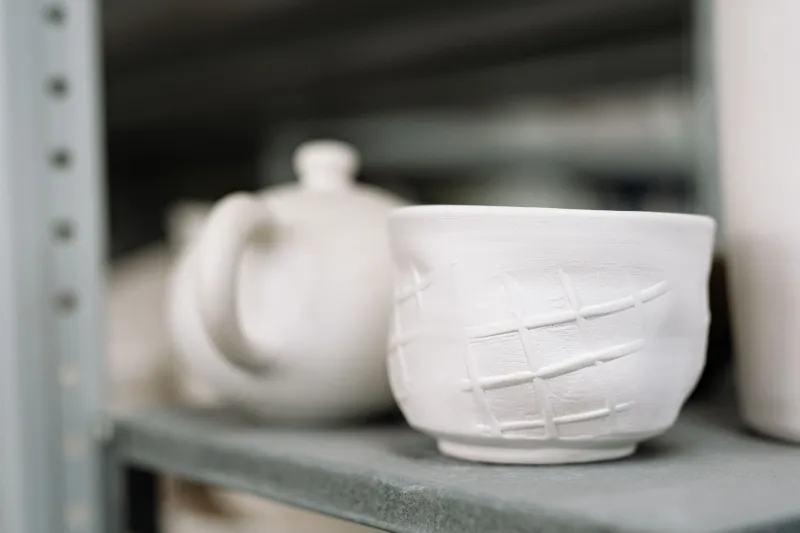
The shelf held a half-sanded oak frame, three glaze test tiles, a plaster cast that had cracked in the mould, a sketchbook open to a page of scribbled shapes, and a small pile of sticky notes with dates and arrows on them. None of it was for sale. Most of it was not even good. It was the sort of thing I usually sweep into a drawer before anyone arrives.
I set it out because the polished wall was starting to bore me. Every open studios weekend has the same rhythm: people walk in, say something kind about the light, look at the finished pieces, ask how long they take, then leave. A finished piece can answer that question only vaguely. I wanted to see what happened if I let the working bits speak first.
What Visitors Actually Did
They gravitated to the shelf. Not because unfinished work is automatically more interesting, but because it gave them permission to ask questions that the finished wall discouraged.
One woman picked up a glaze tile and said, 'Is this the colour you rejected?' I said yes. She said, 'Good, because I like it more than the ones on the wall.' A man spent ten minutes with the half-sanded frame, running his finger along the edge where I had stopped. He said he liked seeing where the sanding stopped. A teenager asked if the sticky notes were part of the piece. I said no. She said, 'Good, because they're the best bit.' That stung and helped in equal measure.
Another visitor asked whether I always work in series. Someone else asked how long it takes me to say no to an idea. Those are useful questions. They are also the kind of questions a portfolio rarely invites.
The Blue-Tape Problem
There is a limit to this. Showing process is not the same as showing disarray. I learned to tell the difference between unfinished and unmanaged.
Blue tape with no explanation is clutter. A label saying 'testing glaze 4 of 7 — too green under warm light' is an invitation. Sticky notes need dates or they look like a cry for help. The half-sanded frame needed one line: 'Stopped here because the grain went wild at the corner.' Without that, visitors thought I had run out of time. With it, they looked closer.
So the shelf was not a dumping ground. It was edited. Three objects would have been enough. I had about a dozen, and the weaker ones diluted the useful ones. Next time I will be stricter about what earns a place.
Why It Mattered for the Work
The shelf changed what people said about the finished pieces. They started asking about decisions rather than price. One person asked whether I always work in the same palette. Another asked what I had changed my mind about halfway through. That is a much better conversation than 'How long did that take?'
It also sold work. Two people bought from the finished wall after spending time at the shelf. I do not think process display is a sales trick, but it does lower the temperature. It makes the polished thing feel made by a person who had to choose.
What This Means for Creative Portfolios in 2026
Most portfolios in 2026 are still built like shop windows: best foot forward, context hidden, case study reduced to before-and-after. That is fine for some clients. But a portfolio that only shows outcomes asks visitors to trust a highlight reel.
I am not arguing for publishing every bad sketch. I am arguing for one deliberate crack in the facade. A project page with a mid-point photo. A caption that says what you changed your mind about. A 'what I would do differently' line that is not a humblebrag. In 2026, with so much work generated at speed, evidence of human decision-making is the differentiator. Not mess for mess's sake. Evidence.
A shelf of process gives people a way in. It says: this is not a magic trick, it is a series of choices, and some of them were wrong. That is reassuring. It is also more memorable than another grid of finished images.
A Small Method for Showing Process
If you want to try this at your next open studios, fair or portfolio review, here is the method I will use again.
- Choose three objects, not thirty. One material test, one abandoned direction, one thing you are actively stuck on.
- Label each with a decision, not an apology. 'Tried this, too heavy, moving on' beats 'sorry, unfinished'.
- Put the shelf slightly away from the main display. People need to choose to look. Choice makes them curious.
- Keep a notebook nearby. Not to show off, but to write down what they ask. The questions are the real audience research.
- End the shelf with one finished piece that came from the experiments. It closes the loop without pretending the process was tidy.
What I'd Do Differently
I would print a small sign explaining the shelf in one sentence. I would have fewer sticky notes and more dates. I would put the half-sanded frame at eye level, because people wanted to touch it and I had put it too low. I would also resist the urge to explain everything. The best moments were when someone asked a question I had not prepared for.
Open studios weekends are odd, generous things. People come in out of the rain, look at your work and try to work out who you are. The finished wall tells them what you can do. The half-finished shelf tells them how you think. In 2026, that might be the more useful thing to show.