Margin Notes and Recurring Shapes: What Twelve Months of Scratchy Sketchbooks Taught Me About My Actual Taste
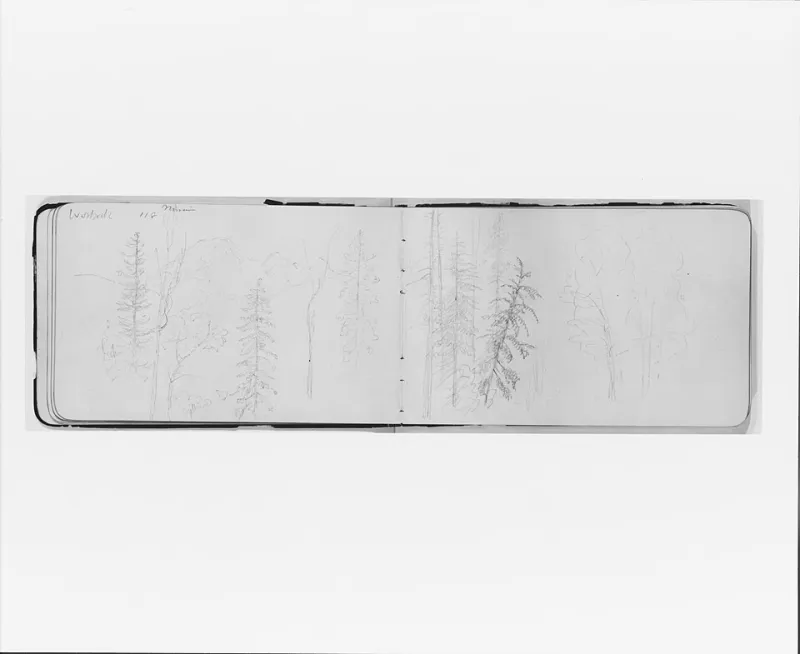
Photo: Albert Bierstadt, CC0, via Wikimedia Commons
On the first day of January 2026 I cracked open a fresh sketchbook with the usual quiet optimism: this one will be tidy. It was not. By November it had coffee rings, a pressed leaf from a walk near the canal, and three pages of increasingly desperate lettering experiments. When I finally spread twelve months of notebooks across the living room floor, I was not looking for finished work. I was looking for evidence. What did I keep circling back to when nobody was asking for a deliverable? That question turned into the most useful creative audit I have done in years.
The pile that wouldn't lie
An audit sounds clinical. This was more like sorting through a compost heap. There were pages I had forgotten, ideas that had seemed urgent in March and baffling by June, and a lot of half-drawn windows. I made three piles: keep, maybe, and what was I thinking. The last pile was not a failure. It was a map of passing enthusiasms.
Once the pages were out of the book and side by side, patterns appeared. I draw windows constantly. Not grand architectural windows, but the front windows of charity shops, cafés and suburban semis. I draw bus stops, queue barriers, hand-painted signs and the backs of people waiting. I use the same four colours over and over: a sour green, a faded pink, ochre and a dark ink blue. Apparently my taste is less 'bold new direction' and more 'British high street at 4pm in November'.
What kept surfacing
The recurring motifs were not random. They were all about in-between places: the spaces where people wait, browse, shelter or kill ten minutes. That is where my eye goes. The subjects I return to are ordinary civic details, the kind that rarely get a gallery wall but carry a lot of local life. On a practical level, the audit gave me a short list of things I actually care about: signage, thresholds, weather, small acts of display.
If you want to try this, start with a twenty-minute sort. Put every page on the floor, even the embarrassing ones. Then ask three questions. What do I draw without thinking? Which pages still have energy, even if they are messy? What am I avoiding? That last question is often the most useful. My sketchbooks are full of buildings but light on people, which tells me something about where I hide.
The projects that never made the portfolio
There were several. A zine about seaside arcades stalled at the layout stage because I tried to make it too clever. A poster series for a fictional chip shop never got past two roughs. A mural pitch died because I waited for a perfect brief that was never coming. A set of ceramic tile tests is still in a box, wrapped in newspaper.
Looking at them together, the problem was rarely the idea. It was scale. I kept turning small, specific observations into projects that felt like they needed permission, funding or a grand statement. The sketchbook did not care about any of that. It just kept recording what I noticed.
The lesson is not to finish everything. Some ideas are better as notes. The lesson is to notice which ones keep coming back. The seaside arcade idea has reappeared in three different notebooks. That is not a failure; that is a signal.
A practical audit for your own shelf
Here is a simple version you can do with a pile of old notebooks and a free afternoon.
- Spread the work out. Do not judge it page by page. Judge it in groups.
- Tally your colours. Not the ones you wish you used, the ones that are actually empty.
- List your subjects in plain language. 'Doors' is fine. 'Liminal typologies' is not.
- Mark the pages that still make you want to make something. Ignore whether they are good.
- Write one page of notes titled: What I seem to be circling.
- Choose three motifs to develop and one to retire for now.
- Give yourself a small, public deadline. A zine swap, a local open studio, a post on your own site.
For UK creatives, the local material is right there. The walk to the shop, the leisure centre noticeboard, the charity shop window display, the weird font on a takeaway menu. You do not need a trip to a big city to find it. You need to stop treating ordinary places as background.
What I am changing for the rest of 2026
I have bought fewer supplies and kept one pocket notebook going instead of three. I am making a monthly contact sheet of rough pages so I can see the patterns sooner. I am also trying to share the unfinished stuff, which is uncomfortable but useful. Taste is not a verdict. It is a trail. The sketchbook is where the trail is clearest.