Between Two Stations: A Month of Small Drawings Made in Transit
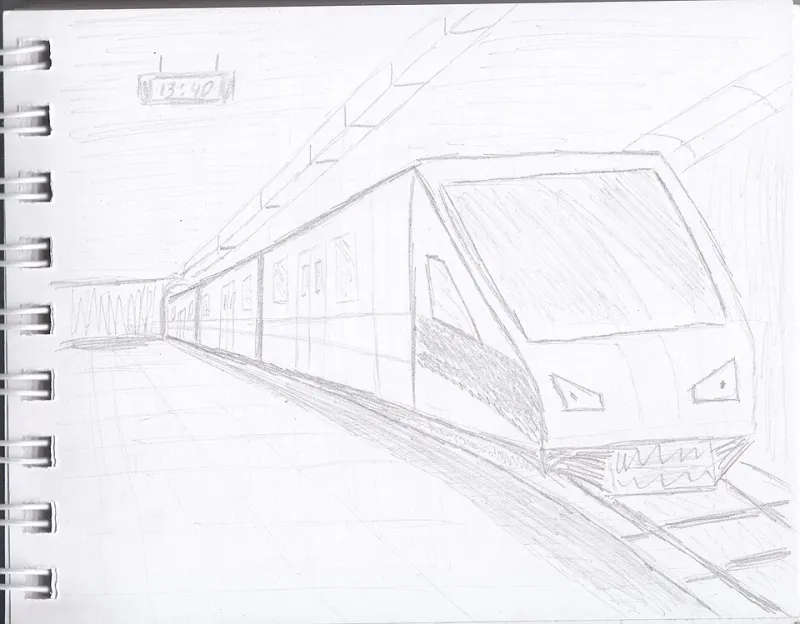
Photo: Sergey A. Demidov, CC BY 4.0, via Wikimedia Commons
I didn’t set out to make a body of work. I set out to stop treating the commute as a dead zone. The plan was almost too simple: one A6 sketchbook, one pencil, one fineliner, no eraser. Same service each weekday morning — the sort of suburban line into a city centre where the table has a faded sticker about priority seats and the lighting is either too orange or not there at all. Four weeks. The train was the studio.
The rules were almost embarrassingly small
Three rules. Draw only while the train is moving. Never work longer than one stop-to-stop stretch. Do not fix anything afterwards. That was it. The sketchbook lived in my coat pocket, which meant it came out at the same time as my ticket. No ceremony, no playlist, no clearing the desk. You sit down, you open the book, you draw until your stop.
The subjects were whatever the carriage offered. The back of a seat. The angle of a stranger’s elbow. The repeated window shapes. The way the overhead lights flickered through a tunnel and turned everyone briefly green. I wasn’t trying to make portraits of tired commuters — that feels intrusive and, frankly, a bit odd at 9:17 in the morning. I was drawing edges, gaps and rhythms. The triangular space between two seats. The curve of a handrail. The square of a ticket machine. Small things, repeated.
What the carriage actually looks like when you look
The same journey is never the same journey. Monday’s carriage has a different set of shoulders and bags. Tuesday’s light is flatter. By Wednesday you start noticing repetition everywhere: the same window frame, the same poster position, the same patch of floor. Repetition is a language. It’s also a shortcut to composition. When you have ten minutes and a moving table, you stop waiting for a grand subject and start using what’s in front of you.
Bad lighting stopped being an excuse. It became a constraint, and constraints are useful. On a train you can’t control the view, the temperature or the person who sits down opposite you and immediately opens a laptop. You can only decide what to put on the page. That turned out to be the whole lesson.
Why moving changed the work
In the studio, I can fiddle. I can sharpen a pencil, rearrange the desk, wait to feel ready. On a train, the pencil rolls off the table and the stop is coming. You learn to commit. The line has to be right enough. You can’t overwork a drawing that has to be finished before the doors open.
At home I’d been spending too long on single pieces. The commute made me value the first mark again. It also made me notice that my studio work had become static — same view, same chair, same light. The train gave me a different rhythm: short bursts, repeated daily. That rhythm carried back. I started setting a timer for warm-up sketches in the studio because the commute had taught me that ten minutes is enough to find a shape worth chasing.
The prompts I’d pass on
If you want to try this, keep it small. A pocket notebook is less intimidating than a proper sketchbook, and a pencil is quieter than a pen. Some prompts that worked for me:
- Draw the negative space between two passengers.
- Draw the same window three times in three different light conditions.
- Draw only the things that are bolted down.
- Draw one square foot of floor.
- Draw the sound of the train as a set of repeated marks.
These aren’t just drawing prompts. They work for notes, photographs or voice memos. The point is to lower the barrier. You don’t need a studio, a free afternoon or a good idea. You need a gap in the day and something to put marks on.
What I didn’t expect
I expected to get better at drawing people. I didn’t. I got better at noticing. And I got less precious. The sketchbook became a place to put the day, not a portfolio. Some pages are rubbish. Some are just a line and a smudge. That’s fine. The month also made me realise how much of my studio time was performance — arranging the desk, choosing the playlist, waiting to feel ready. The train offered no such ceremony.
Back in the studio
The experiment ended but the habit didn’t. I still carry the small book. I still use the one-stop rule for warm-ups. The commute sketches sit in a drawer, not on the wall. They aren’t finished things. But they taught me that constraints are a gift and that motion can be a studio. If you’re stuck, take the smallest book you own on your normal journey. Draw what’s in front of you. Get off at your stop. That’s the whole method.